
Big Island legislators secured over $200 million in Capital Improvement Project (CIP) funding for various projects across the island in HB500 CD1, the state budget bill for the next fiscal biennium.
The proposed budget includes funding for various highway improvements, monies for Big Island schools, and continued financial support to complete the Kona Judiciary Complex. The measure is scheduled next week for final reading in both the House and Senate.
Hilo
“Our Hawaii Island Legislative delegation has worked very hard to secure funding for many of the much needed projects throughout our island,” said Rep. Richard Onishi (Hilo, Keaau, Kurtistown, Volcano). “Although we didn't get everything we asked for and that is needed for our communities, our residents can be assured that we will continue to work hard during the interim to secure funding for those projects.”
“We have been successful in securing funds for Capital Improvement Projects for Hilo although we were faced with fiscal restraints,” added Sen. Gilbert Kahele (Hilo).
“For the last several years, I have been working with the tech community to increase the availability of jobs for Hawaii Island residents,” said Rep. Mark Nakashima (Hamakua, North Hilo, South Hilo). “The $8.5 million available for the purchase of a Workforce Development Facility to support tech activities demonstrates the state's commitment to growing this important economic sector.”
“House District 2 will see funding for schools, infrastructure improvements, and major construction for our airport, harbor, and roads,” added Rep. Clift Tsuji (Keaukaha, parts of Hilo, Panaewa, Waiakea).
“I am a strong supporter of alternative learning for our young men and women, and so I am grateful that an additional $1.7 million is being invested for the Youth Challenge Academy in Keaukaha. The Hilo Airport and Harbor continue to receive funding for necessary improvements.
“Other smaller projects are just as important, like Waiakea High School's batting cage and pipeline replacement along Nohea Street and Santos Lane. Regardless of the amount, project dollars will improve our quality of life and provide continued economic activity.”
Kohala, Waimea
“Two of my priorities are farming and agriculture and I am pleased that three projects in Senate District 4 have received funding,” said Sen. Lorraine Inouye (Hilo, Hamakua, Kohala, Waimea, Waikoloa, Kona). “After being invited to visit the Kohala Ditch to witness the damage in December, improvements and repairs to the ditch became my top priority for the future of agriculture. With the collaboration of many constituents and the State Department of Agriculture, we submitted a CIP request and were approved for $1.5 million.
“The Kamuela Vacuum Cooling Plant, is another project and my office staff and I have met with them to clarify their needs” she added. “This operation is vital to the farmers in the greater Waimea community. A CIP for $1 million to help repair their equipment has also been awarded. And finally, for Waipio Valley, and specifically Ha Ola o Waipio Valley, a GIA in the amount of $150,000 has been approved for flood control and stream bank stabilization work.”
“I'm pleased the budget contains funding for North Kohala and South Kohala and makes progress on locally grown produce and much needed improvements for our public schools,” said Rep. Cindy Evans (North Kona, North Kohala, South Kohala).
Puna, Ka’u
“For Puna & Ka’u districts, I’m happy to announce that our district schools will receive $2.3 million for laptops and the school infrastructure needed to implement the ‘One on one’ computer learning program, starting with Pahoa and Mountain View public schools,” said Sen. Russell Ruderman (Puna, Ka’u).
“This will expand the program that has been so successful in Keaau Elementary & Intermediate schools. Our Puna public school students, many of whom are extremely challenged economically, will have the tools to compete in our modern computer-based workplace.”
“Lower Puna is the fastest growing district in the State and I appreciate that the current budget recognizes our road and traffic problems by allocating $15 million for improvements to Highway 130,” added Rep. Joy San Buenaventura (Puna).
Kona
“After many years fighting for projects like the Kona Courthouse, I was so pleased to see our team's collaboration pay off for the Big Island,” added Sen. Josh Green (Kona, Ka‘u).
“The Kona Courthouse was a top priority for me and I’m very thankful that we now have full funding and the project will move forward,” said Rep. Nicole Lowen (Kailua-Kona, Holualoa, Kalaoa, Honokohau). “The funds in the budget for the airport are also really important for Kona’s future—the federal inspections stations will cement Kona as a destination for international arrivals to the state, and the planned regional ARFF training facility will serve as a source of revenue to keep our airports systems sustainable.
“We were gratified the two projects in District 5 received grant-in-aid money,” said Rep. Richard Creagan (Na'alehu, Ocean View, Capt. Cook, Kealakekua, Kailua-Kona). “The community kitchen project at Kona Pacific Charter School will receive $1.2 million. This project will help provide healthy food and value added products to the Kona community.
“The Community Enrichment and Historical Center in Precinct 3 will receive $800,000 which should help complete this very important and long-awaited project.”

Notable CIP funding highlights for Hawaii County include:
- $55 million in continued funding for the design and construction of a Judiciary Complex in Kona
- $4.99 million for photovoltaic projects for East Hawaii HHSC region
- $1 million for the design and construction of a Kamuela post-harvest facility and vacuum cooling plant
- $1.5 million for improvements to the Kohala ditch irrigation system
- $30.212 million for the construction of a new combined support maintenance shop complex for Hawaii Army National Guard at the Keaukaha military reservation
- $1.675 million for Youth Challenge Academy renovations and improvements at Keaukaha military reservation
- $300,000 for parking improvements at Kealakehe Elementary School
- $1 million for the plans, design, construction and equipment for the transition from Keaau Elementary School to Keonepoko Elementary School
- $230,000 for the construction of drainage improvements and a raised covered walkway at Mountain View Elementary School
- $2.3 million for laptop computers and the installation of necessary infrastructure for laptop use in Senate District 2 schools, especially at Pahoa High and Intermediate School and Mountain View Public Schools
- $450,000 for a new baseball batting cage at Waiakea High School
- $1.58 million for the design of a new classroom building at Waikoloa Elementary and Middle School
- $300,000 for parking improvements at Kealakehe Elementary School
- $2 million for the design of Building A phase 1 renovations at Hilo Intermediate School
- $8.5 million for the land acquisition, design, construction and equipment for a multi-purpose workforce development processing facility
- $330,000 for improvements to the research campus in the Hawaii Ocean Science and Technology Park
- $1 million for the design and construction for Pu’u Wa’awa’a structure improvements and dam compliance
- $400,000 for the plans and design for improvements at the North Kawaihae small boat harbor
- $600,000 for the land acquisition and design for a community center in Waiakea Uka
- $550,000 for the replacement of water lines and service laterals along Nohea Street and Santos Lane
- $3.5 million for airfield improvements at Hilo International Airport
- $3.89 million for the demolition of existing structures at the west ramp and construction of site improvements at Hilo International Airport
- $61 million for the design and construction of a new airport rescue firefighters regional training facility at the Kona International Airport at Keahole
- $2.5 million for the plans and design of a federal inspection station at Kona International Airport at Keahole
- $50,000 for a feasibility study of constructing a small commercial airport in south Puna
- $1.425 million for physical modifications to improve navigational safety and operational efficiencies at Hilo Harbor
- $660,000 for land acquisition to extend the Daniel K. Inouye Highway from the Hilo terminus to the Queen Kaahumanu Highway
- $15 million for repair and maintenance of feeder roads and alternate routes for Highway 130
- $2.45 million for Keaau-Pahoa Road improvements to widen the two lane highway to four lanes or implement alternate alignments
- $3.6 million for Kohala Mountain Road drainage improvements by mile post 10.60
- $8 million for the rehabilitation of Ninole Bridge along Mamalahoa Highway (route 11)
- $1.5 million for the construction of portable trailers at Hawaii Community College
- $800,000 to the Hawaii County Economic Opportunity Council #1 for the construction of Milolii community enrichment and historical center (Grant-in-Aid)
- $150,000 to the Panaewa Community Alliance for the design of the Kamoleao Laulima Community Resources Center (Grant-in-Aid)
- $285,000 to the Friends of the Volcano School of Arts & Science for the design and construction of a certified commercial kitchen (Grant-in-Aid)
- $1.2 million to the Friends of Kona Pacific Charter School for the design, construction and equipment for community food kitchen for Friends of Kona Pacific Public Charter School (Grant-in-Aid)
- $315,000 to the Kailapa Community Association for the design and construction of the Kailapa community resource center (Grant-in-Aid)
Contact Information:
Senators
Senator Gilbert Kahele (Hilo)
808-586-6760
senkahele@capitol.hawaii.gov
Senator Russell Ruderman (Puna, Ka‘u)
808-586-6890
senruderman@capitol.hawaii.gov
Senator Josh Green (Kona, Ka‘u)
808-586-9385
sengreen@capitol.hawaii.gov
Senator Lorraine Inouye (Hilo, Hamakua, Kohala, Waimea, Waikoloa, Kona)
808-586-7335
seninouye@capitol.hawaii.gov
Representatives
Representative Mark Nakashima (Hamakua, North Hilo, South Hilo)
(808) 586-6680
repnakashima@capitol.hawaii.gov
Representative Clift Tsuji (Keaukaha, parts of Hilo, Panaewa, Waiakea)
(808) 586-8480
reptsuji@capitol.hawaii.gov
Representative Richard Onishi (Hilo, Keaau, Kurtistown, Volcano)
(808) 586-6120
reponishi@capitol.hawaii.gov
Representative Joy San Buenaventura (Puna)
(808) 586-6530
repsanbuenaventura@capitol.hawaii.gov
Representative Richard Creagan (Naalehu, Ocean View, Capt. Cook, Kealakekua, Kailua-Kona)
(808) 586-9605
repcreagan@capitol.hawaii.gov
Representative Nicole Lowen (Kailua-Kona, Holualoa, Kalaoa, Honokohau)
(808) 586-8400
replowen@capitol.hawaii.gov
Representative Cindy Evans (North Kona, North Kohala, South Kohala)
(808) 586-8510
repevans@capitol.hawaii.gov
House and Senate budget conferees funded $28 million in Grant-in-Aid (GIA) for local organizations serving the public and working to improve the state of Hawaii. The total appropriations, amounted to nearly $20 million in capital improvement projects (CIP) funding and $8 million in operating funds. The funding agreements were made as lawmakers agreed on House Bill 500, relating to the state budget.
Lead by House Finance Chair Sylvia Luke and Senate Ways and Means Chair Jill Tokuda, the two sides focused on developing a responsible financial plan that lawmakers hope will create a continuing mindset in state government of “spending within its means.” That’s why lawmakers are looking to control government growth and spending even in good years.
“This year we received over two hundred eighty applications for Grant-in-Aid assistance. It was tough to make a decision from the many worthwhile requests, but the decisions that we made fit into what we could afford in this year’s state budget and our conservative fiscal plan,” said Rep. Ty Cullen (Royal Kunia, Village Park, Waipahu, Makakilo, West Loch), lead House GIA manager.
“Fortunately, the House and Senate were able to put together just over $28 million to support our local community and service groups, who assist a wide range of individuals within our community and are an integral part of our social safety net providing essential services for our state.”
The agreement culminated nearly two weeks of discussions on a wide range of issues such as social services, mass transit, healthcare, education, the environment and support for statewide government services. HB500, CD1 will now go before the full House and Senate for a final vote.
All GIA applications received this year and the full list of operating and CIP appropriations are available on the Capitol website at http://www.capitol.hawaii.gov/GIA/2015GIA.aspx.
.jpg)
House and Senate conferees today agreed to authorize the Maui Regional System (MRS) of the Hawaii Health Systems Corporation (HHSC) to enter into an agreement with a private entity to transition one or more of its facilities into a new private, nonprofit corporation.
Lawmakers amended HB1075, CD1, requiring MRS to re-solicit proposals from any party locally and nationally interested in partnering with it to operate its hospitals. It will also allow the Governor to direct negotiations for the transfer of MRS facilities to protect and further the state’s interest in controlling the levels of financial support for HHSC operations and maintaining current levels of access to healthcare services on Maui.
The measure will also preserve all rights, benefits and privileges earned by HHSC employees and requires the new nonprofit management to offer employment to all employees of facilities transferred for at least six months.
In addition, the measure would cap the state’s financial support to the transitioned facilities at the amounts provided in fiscal year 2014. Transitioned facilities will also be eligible to apply for Capital Improvement Project (CIP) funds for up to the first 10 years.
Recent projections provided to the Legislature forecasted a deficit of about $800 million over the next 10 years for the Maui hospitals and, in March, the Maui Regional board announced plans to cut $28 million in services and positions at Maui Memorial Medical Center for the upcoming fiscal year.
“This action was absolutely essential for the people of Maui,” said the bill’s introducer, Speaker Joseph M. Souki (Kahakuloa, Waihee, Waiehu, Puuohala, Wailuku, Waikapu). “The financial situation for Maui Memorial was not sustainable for the short or long run, and a private-public partnership is the best solution for Maui and the state of Hawaii.
“What we did today will open the doors for a vital public-private partnership to keep Maui’s hospitals open and to most importantly provide the appropriate and quality care for the people of Maui County. I thank Governor Ige for his leadership in bringing everyone to the table to work together on a bill that will have a significant impact on the lives of Maui County residents.”
Health Committee Chair, Rep. Della Au Belatti (Makiki, Tantalus, Papakolea, McCully, Pawaa, Manoa) who led discussions for the House said, “Our collective goal was to come up with a bill that addresses concerns that include fairness, employment, expenses, efficiency, quality and accessible health care to the residents of Maui County.”
House Majority Leader, Rep. Scott K. Saiki (Kaheka, Kakaako, Downtown said, “This bill allows for all interested parties, locally and nationally, to come to the table with proposals. It re-enforces the vetting process and enables us to find the best fit for Maui Hospital and the health care needs of Maui County residents.”
“It was important to all of us, particularly the Senate, that any transition did not disrupt any services, for the people of Maui and hopefully grow health services there quite quickly,” said Health Committee Chair, Sen. Josh Green (Kailua-Kona, Honokohau, Honaunau, Captain Cook, Kealakekua). “We expect Maui Memorial will find a strong partner for the Maui health care system quickly so that everyone can move forward. We also didn’t want people to lose benefits or jobs and there are provisions in the bill to make sure we do everything we can to continue a strong employment environment on Maui.”
This past November, the House Committee on Health held an informational briefing at Maui Waena Intermediate School on Maui to hear from MRS officials and the community. The meeting was part of a series of community-based public hearings related to the Hawaii Health Systems Corporation, its Regional Boards, and their plans to streamline operations and address anticipated budget shortfalls. Informational briefings were also held on Oahu, Kauai, and the Big Island in Kona and Hilo.
The Hawaii Health Systems Corporation is a statewide public health system and is the only acute care provider on the islands of Maui and Lanai. HHSC is the “safety net” for neighbor island acute care and for long-term care throughout the state.
The system operates over 1,300 licensed beds in facilities located on five different islands and relies on state appropriations to provide services and capital improvements and maintenance of its health facilities. However, the HHSC has continued to operate at a deficit and requires significant public funding and emergency appropriations to remain operational.
House conferees are Representatives Sylvia Luke, Mark Nakashima and Della Au Belatti, co-chairs; Kyle Yamashita and Cynthia Thielen, managers. Luke, Nakashima and Belatti also serve respectively as the chairs of the House Committees on Finance, Labor and Health.
Senate conferees are senators John Green, chair; Roz Baker, Gilbert Keith-Agaran, Jill Tokuda, co-chairs; and Sam Slom, manager.
The bill now goes to a vote before the full House and Senate. If passed by both chambers, the measure will go to the Governor, who has the option of signing the bill into law, vetoing the measure, or allowing it to become law without his signature.
House and Senate conferees met today to continue negotiations on a final version of HB500, the state budget bill. The conferees opened discussion on the state budget earlier this week on Tuesday, April 21st. They will continue meeting to iron out the differences between the two versions through May 1, the deadline for all fiscal bills to pass out of conference committee.
A final conference draft will then be voted upon by the Legislature and, if approved, will be sent to the Governor for his signature.
At today’s meeting, the committees highlighted several additional budget items upon which there was agreement in the House and Senate budget drafts.
- $5,123,726 FY16 for the Department of Education school food service programs
- $102,846 FY16 and $213,978 FY17 for 4 Vector Control Worker positions for increased surveillance at state ports
- $545,030 FY16 and $545,030 FY17 for licensing and case management activities for adult foster family care homes and adult day care facilities
- $217,033 FY16 and $270,747 FY17 special funds for 2 positions for the Historic Preservation Division
- $47,000 FY16 and $94,000 FY17 for two Program Specialists for homeless services
- $10,000 special funds, in each year, for the Office of the Attorney General’s Internet Crimes Against Children Special Fund
- $27,000, in each year, for replacement body armor for deputy sheriffs.
- $545,600 FY16 and $545,600 FY17 in revolving funds for the Department of Agriculture to replace motor vehicles
- $101,642 FY16 and $206,787 FY17 for 3 Retirement Claims Examiners to manage increased workload
- $49,190 FY16 and $95,000 FY17 for one Office of Homeland Security Administrator position
- $300,000, in each year, for 2 temporary positions for the Governor’s Office of Military Affairs and Grant Maximization
- A total of $170,611, in each year, for 2 Adult Protective Services Specialists and 1 Social Services Aid for adult protective and community services
- $200,000, in each year, for the in-service training and program effectiveness project for state employees
- $34,836, in each year, for 1 Medical Security Officer for the Hawaii State Hospital
- $400,000 FY16 and $250,000 FY17 special funds for Maui Stormwater Program
- $300,000 FY16 and $300,000 FY17 special funds for Oahu Stormwater program
Budget worksheets detailing the appropriations in the overall Executive, Judiciary and Office of Hawaiian Affairs budget bills are available on the Capitol website at http://www.capitol.hawaii.gov/budget/2015budget.aspx.
The House Conferees are: Representatives Sylvia Luke, Chair; Romy Cachola, Ty Cullen, Lynn DeCoite, Aaron Johanson, Jo Jordan, Jarrett Keohokalole, Bert Kobayashi, Nicole Lowen, Scott Nishimoto, Richard Onishi, James Tokioka, Kyle Yamashita, Feki Pouha, Gene Ward.
The Senate Conferees are: Senators Jill Tokuda, Chair; Ron Kouchi, Suzanne Chun Oakland, Donovan Dela Cruz, Kalani English, Brickwood Galuteria, Breene Harimoto, Lorraine Inouye, Gil Riviere, Russell Ruderman.
The conference committee is scheduled to reconvene Tuesday, April 28, at 2:00 p.m. in room 309.
The Legislature today passed on final reading, SB1030, SD1, HD2, which increases the minimum age from 18 to 21 for the sale, possession, consumption, or purchase of tobacco products or electronic smoking devices. If signed by the Governor, the measure takes effect on January 1, 2016.
The passage of this bill makes Hawai‘i the first state in the nation to raise the minimum age of legal access to tobacco products, including electronic smoking devices to 21.
“I’m very pleased to be a part of passing this landmark legislation that will save lives,” said Senator Rosalyn Baker, Chair of the Senate Committee on Commerce and Consumer Protection. “Lives saved, human suffering averted, healthcare costs reduced by increasing the age to legally purchase tobacco products equals good public health policy. That’s what we did today.”
“According to the U.S. Surgeon General, 95% of all adult smokers start smoking before the age of 21, and three out of four teenage smokers continue to smoke into adulthood. With the passing of this bill, like the ordinance recently passed in Hawaii County, our state is once again leading the way and taking a proactive, public health approach to help prevent our young people from trying and becoming addicted to tobacco products,” said House Health Chair, Representative Della Au Belatti.
“This bill does more than just raise the purchase age of tobacco products and e-cigs to age 21. It also conveys a zero tolerance for purchase and consumption of tobacco products,” said Senator Glenn Wakai.
This was a nine year effort for Sen. Wakai, who partnered with students from Moanalua High School in 2006. They identified this loophole and introduced a consumption prohibition bill. That bill has been reintroduced each year since then.
“Children were getting a mixed message - they couldn’t buy cigarettes, but it was perfectly fine for them to light up,” says Sen. Wakai, “Today we snuffed out that glaring loophole.”
This measure defines “tobacco products” to include electronic smoking devices that can be used to aerosolize and deliver nicotine or other substances to the person inhaling the device.
Any person under 21 years of age who is caught in possession or consumption of a tobacco product will be fined $10 for the first offense. The fine for subsequent offenses will be $50 or up to 72 hours of community service.
Anyone caught selling tobacco products or electronic smoking devices to persons under 21 years of age faces a fine of $500 for the first offense. Subsequent offenses are subject to fines of $500 to $2,000.
The bill extends the exemption to allow persons under the age of 21 to participate in police or Department of Health sanctioned tobacco sales sting operations.
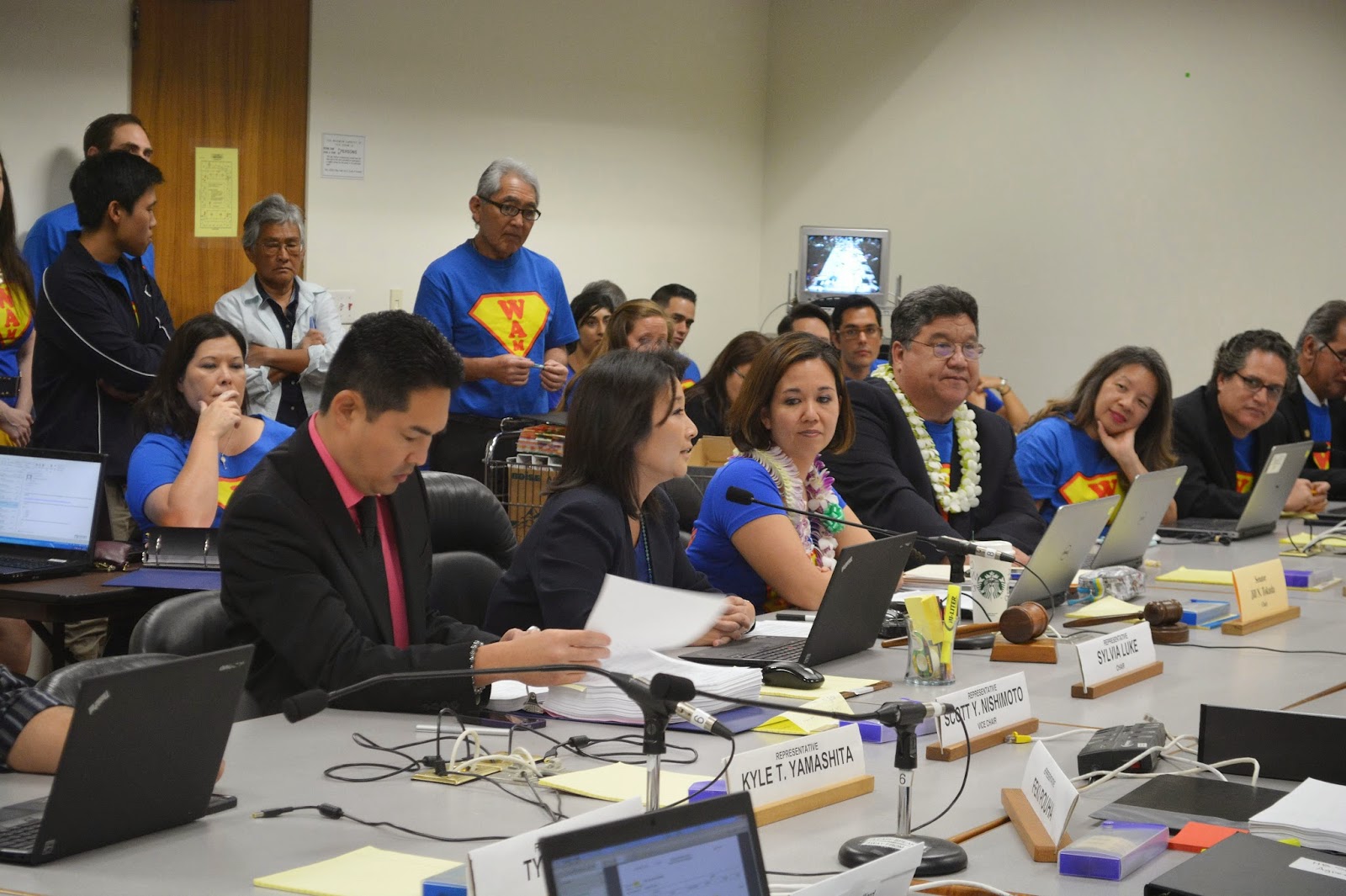
House and Senate conferees met today to begin negotiations on a final version of HB500, the state budget bill. Earlier, the House Finance Committee and the Senate Ways and Means Committee crafted their respective versions of the budget. They will continue meeting to iron out the differences between the two versions through May 1, the deadline for all fiscal bills to pass out of conference committee.
A final conference draft will then be voted upon by the Legislature and, if approved, will be sent to the Governor for his signature.
“As we set the budget for the current biennium, I am hopeful that we’ve turned a significant corner in creating a new mindset for state government to live within our means and not spend more than we take in,” said Rep. Sylvia Luke (Makiki, Punchbowl, Nuuanu, Dowsett Highlands, Pacific Heights, Pauoa), House Finance Committee Chair. “No raiding the rainy day fund, no putting off payments to state employees’ retirement system, and no borrowing on our children’s future.”
Luke said that approach means making measured and reasonable decisions that consider both immediate and long-term financial obligations.
“It all comes down to using the kind of common sense ‘pocketbook’ mentality that we all exercise in our personal daily lives,” Luke said.
The Senate Ways and Means Committee Chair, Sen. Jill Tokuda (Kaneohe, Kaneohe MCAB, Kailua, Heeia, Ahuimanu) reiterated the efforts made to create a budget that best represents the legislature and is responsible to taxpayers.
“We are on track to deliver to the Governor a budget that is fiscally prudent and reflects both the legislative priorities and appropriate oversight responsibilities that are important to the Senate and the House. In the days to come, we’ll have tough decisions to make on critical need areas ranging from social services to natural resource protection to education, while continuing to meet the significant obligations we have as a state,” said Sen. Tokuda. “As we go through these deliberations, we are constantly aware that these costs are borne by our taxpayers, and we have a fiduciary responsibility to provide services to them while ensuring these resources are efficiently used and sustained.”
The committee highlighted several budget items upon which there was agreement in the House and Senate budget drafts.
· $921,000 special funds, in each year, for maintenance of the Zipper Lane
· $3,647,425 general funds, in each year, for increasing school lunch costs
· $700,000 revolving funds, in each year, for improvements to the criminal history record program
· $1,000,000 special funds, in each year, for parks administration and operations
· $1,000,000 special funds, in each year, for the Hawaii Green Infrastructure Authority
· $2,997,000 general funds, in each year, for projected deficits at the Hawaii State Hospital
· $635,000 general funds, in each year, for intermediate care facility costs for persons with intellectual disabilities
· $18,790,387 FY16 and $36,045,924 FY17 for collective bargaining increases for UHPA Members
· Establish a new program ID for the Charter School Commission
· $2,600,000 general funds, in each year, for general assistance payments
· $299,000 FY16 and $254,500 FY17 special funds for food sanitation health services
· $1,000,000 FY16 special funds to upgrade the State Lands Information Management System
· $250,000 FY16 and $500,000 FY17 special funds for the digitization of archives in the Bureau of Conveyances
· $100,000 general funds, in each year, to support the open data program
· $500,000 in general funds, in each year, for personnel costs in the department of the Attorney General
Budget worksheets detailing the appropriations in the overall Executive, Judiciary and Office of Hawaiian Affairs budget bills are available on the Capitol website at http://www.capitol.hawaii.gov/budget/2015budget.aspx.
The House Conferees are: Representatives Sylvia Luke, Chair; Romy Cachola, Ty Cullen, Lynn DeCoite, Aaron Johanson, Jo Jordan, Jarrett Keohokalole, Bert Kobayashi, Nicole Lowen, Scott Nishimoto, Richard Onishi, James Tokioka, Kyle Yamashita, Feki Pouha, Gene Ward.
The Senate Conferees are: Senators Jill Tokuda, Chair; Ron Kouchi, Suzanne Chun Oakland, Donovan Dela Cruz, Kalani English, Brickwood Galuteria, Breene Harimoto, Lorraine Inouye, Gil Riviere, Russell Ruderman.
The conference committee is scheduled to reconvene Friday, April 24, at 2:00 p.m. in room 309.
.jpg)
The state House of Representatives today passed on final reading HB1272, HD2, SD2, which requires anyone that operates a motion picture theater in more than two locations in the state to provide open captioning during at least two showings per week of each motion picture that is produced with open movie captioning. It also requires them to provide an audio description of any motion picture that is produced and offered with audio description. The measure takes effect January 1, 2016 and sunsets January 1, 2018.
This measure removes communication barriers and provide equal access to persons who are deaf, hard of hearing, blind or have poor vision through reasonable accommodations at movie theaters.
"This bill places Hawai‘i at the forefront in ensuring equal access to movie theaters for our deaf, blind, deaf/blind and hard-of-hearing communities" said the bill’s introducer Representative James Tokioka (Wailua Homesteads, Hanamaulu, Lihue, Puhi, Old Koloa Town, Omao).
"In addition, it will further open Hawaii's doors in achieving full inclusion for our deaf and blind communities that was first initiated with the Americans with Disabilities Act (ADA) of 1990."
The measure was first introduced in the House and amended by the Senate. With the House today agreeing to the Senate’s changes, the bill now goes to the Governor, who has the option of signing the bill into law, vetoing the measure, or allowing it to become law without his signature.
Other measures passed by the House that move on to the Governor include:
HB253, HD2, SD1, authorizes pharmacists to administer vaccines to persons between 14 and 17 years who have a valid prescription from the patient's medical home.
HB279, HD2, SD1, allows the real estate commission to take disciplinary action if a real estate broker or salesperson for a seller or purchaser of real estate acts in a manner that prohibits a prospective purchaser or seller from being able to retain a real estate broker or salesperson. Effective 11/2/2015.
HB1099, HD2, SD2, authorizes the display of an outdoor advertising device at the Waipio peninsula soccer stadium, subject to appropriate approval, provided that the scoreboard faces the stadium interior and is not visible from any thoroughfare. Specifies placement and size limitations for the device.
HB1286 HD2, SD2, amends the state's objectives and policies relating to energy facility systems, including a policy of ensuring that liquefied natural gas be used only as a cost-effective transitional, limited-term replacement of petroleum for electricity generation and not impede the development and use of other cost-effective renewable energy sources.
HB1325, HD1, SD1, authorizes the counties to establish and charge user fees for stormwater management.
HB1410, HD1, SD1, changes statutory references to "Youth Conservation Corps" to the "Hawaii Youth Conservation Corps" to distinguish the state program from other federal and nationally affiliated youth conservation corps programs.
HB1412, HD2, SD1, makes permanent the Department of Education's authority to supervise its accounts. Makes required housekeeping amendments to statutory provisions relating to the department’s fiscal operations.
The state House of Representatives passed today nearly 150 Senate measures dealing with education, housing and homelessness, health, seniors, agriculture, invasive species and the environment, public safety and improving the quality of life for Hawaii residents.
Among the most significant bills passed by the House were SB1028 that attempts to harmonize the requirements of the Affordable Care Act (ACA) with those of Hawaii’s Prepaid Health Care; SB1291 that establishes a regulated system of medical marijuana dispensaries and production centers; SB284 that sets up a funding mechanism for the purchase of the Turtle Bay conservation easement; SB287 that mandates and establishes a timetable for voting by mail for all Hawaii elections; SB1280 that requires the PUC to regulate transportation network companies such as Uber; SB387 that creates an affirmative consent task force on domestic violence, dating violence, sexual assault and stalking at the University of Hawaii; and SB265 that makes sex trafficking a Class A felony.
The majority of the bills, along with the nearly 140 House bills passed by the Senate, will go into conference committees where House and Senate conferees will negotiate differences in the measures and determine which will be presented for final consideration.
Other notable Senate measures passed by the House included:
EDUCATION
SB64, SD3, HD1, relating to the Preschool Open Doors Program. Makes appropriations for positions and the continued implementation of the Preschool Open Doors Program and for subsidies for the program.
SB822, SD1, HD2, relating to education and student hours. Clarifies the implementation schedule and calculation method for minimum number of days and student hours required for Department of Education schools in each school year. Applies the requirement for a 180 day, 1,080 hour school year to all school years beginning with the 2016-2017 school year.
SB1345, HD2, relating to multi-track schools. Requires the Department of Education to develop a transition plan to end multi-track schedules in public schools and report to the Legislature regarding the plan and any proposed legislation. Requires the DOE to give priority to overpopulated schools in making its annual capital improvement budget request to the Director of Finance.
SB854, SD2, HD2, relating to public school lands. Requires public school lands that are leased to benefit public educational purposes rather than simply to be used for public purposes. Authorizes the Department of Education to enter into leaseback agreements.
SB374, SD2, HD2, relating to UH/DOE dual credit education programs. Renames the "Running Start Program" as the "Dual Credit Program." Broadens participation to include public and home-schooled ninth and tenth graders. Replaces a standardized test with an assessment. Repeals tuition and fees requirement. Requires that all additional qualifications be uniform across all campuses. Appropriates moneys to the Department of Education and the University of Hawaii for positions.
HOUSING AND HOMELESSNESS
SB273, SD2, HD2, relating to identification cards for the homeless. Requires the examiner of drivers to accept a sworn statement from a victim services organization, an attorney, a member of the clergy, correctional institution staff, a medical or health professional, or a verification letter from a homeless service provider as documentary evidence of a homeless person's address; requires the Director of Transportation's rules to direct the examiner of drivers to waive all fees for homeless individuals; and establishes a working group to enable homeless individuals in the State to obtain necessary documentary evidence.
KUPUNA
SB964, SD2, HD1, relating to aging. Appropriates funds for the Kupuna Care Program and the Aging and Disability Resource Center. Requires appointment of an Alzheimer's disease and related dementia services coordinator no later than July 1, 2017. Appropriates funds for the Alzheimer's disease and related dementia services coordinator, fall prevention and early detection services for the elderly, the Healthy Aging Partnership Program, and an Alzheimer's disease and related dementia public awareness campaign.
HEALTH AND HEALTH CONNECTOR
SB1028, SD2, HD1, relating to the Hawaii Health Connector. Attempts to harmonize requirements of the federal Affordable Care Act with the Hawaii Prepaid Health Care Act by implementing federal requirements for provider network adequacy through requiring that insurer contracts with federally-qualified health centers. Authorizes other means of generating revenue through provision of benefits administration services.
SB1338, SD2, HD1, relating to the Hawaii Health Connector. Authorizes large group insurance coverage under the Connector. Beginning Oct. 1, 2016, ends authorization to renew or issue transitional renewal policies. Requires notice to group health plans that offer continuation of coverage about options for affordable coverage under the Connector, in addition to the requirements under the Consolidated Omnibus Budget Reconciliation Act of 1985 (COBRA).
SB1228, SD2, HD3 establishes a process for special innovative procurement and generates a framework for public-private partnership in Hawaii. Appropriates funds for a temporary position to assist the Procurement Policy Board. Appropriates funds for the Hawaii Health Systems Corporation to procure services to develop a master plan for the Samuel Mahelona Memorial Hospital and Kauai Veterans Memorial Hospital.
SB1117, SD2, HD1, relating to Hawaii Health Systems Corporation. Makes an emergency appropriation to support the functions of the Hawaii Health Systems Corporation.
SB682, SD2, HD1, relating to medical marijuana. Establishes a regulated system of medical marijuana dispensaries and production centers. Specifies that the number of licensed dispensaries and production centers increase gradually over an initial phase-in period. Prohibits counties from enacting zoning regulations or rules that prohibit the use of land for licensed dispensaries and production centers.
SB1291, SD2, HD2, relating to medical marijuana. Prohibits discrimination against medical marijuana patients and caregivers by schools, landlords, courts with regard to medical care or parental rights, employers, planned community associations, condominium property regimes, and condominiums.
SB1095, SD1, HD1, relating to health insurance. Defines the term "habilitative services" to be included in health care services, including but not limited to physical and occupational therapy, speech-language therapy, speech and swallowing therapy, applied behavior analysis, medical equipment, orthotics, and prosthetics, that help a person keep, learn, or improve skills and functioning for daily living.
SB791, SD1, HD2, relating to autism spectrum disorders. Requires health insurers, mutual benefit societies, and health maintenance organizations to provide insurance coverage for the diagnosis and treatment of autism.
SB1036, SD2, HD1, relating to substance abuse treatment. Establishes within the Department of Health a working group to address publicly-funded substance abuse treatment services. Appropriates funds.
SB768, SD1, HD1, relating to in vitro fertilization insurance coverage. Provides in vitro fertilization insurance coverage equality for women who are diagnosed with infertility by making available to them expanded treatment options, ensuring adequate and affordable health care services.
SB1032, SD2, HD2, relating to tobacco products. Expands the definition of "tobacco products" to include tobacco-free products containing nicotine that are intended for human consumption. Increases the license fee for wholesalers or dealers of cigarettes or tobacco products. Increases the retail tobacco permit fee for retailers engaged in the retail sale of cigarettes and tobacco products.
SB1030, SD1, HD2, relating to health. Increases the minimum age for the sale or possession of a tobacco product in a public place, and the sale or furnishing of a tobacco product, from 18 to 21. Defines "tobacco products" to include electronic smoking devices.
UNIVERSITY OF HAWAII
SB387, SD2, HD3, relating to affirmative consent. Establishes an affirmative consent task force to review and make recommendations on the University of Hawaii's executive policy on domestic violence, dating violence, sexual assault, and stalking.
SB1146, SD1, HD1 requires the University of Hawaii Board of Regents to submit to the Legislature a program performance report for each fiscal quarter showing a comparison of actual revenues and expenditures versus budgeted revenues and expenditures. Extends the University of Hawaii's authority for independent fiscal management and oversight for one additional year.
SB325, SD1, HD2 makes comprehensive omnibus changes affecting the University of Hawaii System. Appropriates funds.
PUBLIC SAFETY
SB265, SD1, HD1, relating to sex trafficking. Replaces the term "promoting prostitution" with the term "sex trafficking," a Class A felony. Includes the offense of sex trafficking in the Department of the Attorney General's statewide witness program.
SB1211, SD1, HD1, relating to the Major Disaster Fund. Intends to increase the expenditure ceiling on Major Disaster Fund moneys. Requires the Adjutant General to report any allotment of fund moneys or any expenditure of Fund moneys to the Legislature within one month of the allotment or expenditure.
SB871, SD1, HD3, relating to highway safety. Authorizes the director of transportation to establish reciprocal licensing privileges to any person eighteen years of age or older who holds a license from another jurisdiction, under certain conditions. Authorizes the examiner of drivers to waive the demonstration of the ability to operate a motor vehicle for individuals with licenses from other jurisdictions who receive reciprocal licensing privileges.
SB979, SD2, HD1, relating to youth. Requires the Office of Youth Services to coordinate a Safe Places for Youth Pilot Program until June 30, 2021. Establishes the Safe Places for Youth Program Coordinator position. Allows youth in crisis who are at least 14 but under 18 years of age to consent to accept services in the Pilot Program under certain circumstances. Appropriates funds.
THE ENVIRONMENT AND INVASIVE SPECIES
SB284, SD2, HD2, relating to the Transient Accommodations Tax and Turtle Bay. Allocates monies to the Turtle Bay conservation easement special fund. Authorizes B&F to issue reimbursable general obligation bonds and to use the proceeds to acquire a conservation easement in Turtle Bay, Oahu. Requires B&F to transfer the conservation easement to DLNR. Allocates monies to B&F to reimburse to the state general fund the debt service on the reimbursement general obligation bonds and ongoing expenses related to the bonds. Requires the Office of Planning to investigate acquiring lands owned by Dole Food Company, Inc.
SB1260, HD1, relating to recycling. Mandates the recommendations made by the Office of the Auditor to the Department of Health regarding advance disposal fee glass containers and glass recycling. Requires the Department of Health to report on its implementation of the recommendations to the Legislature.
SB359, SD1, HD1, relating to the environmental response energy and food security tax. Removes the revenue distribution from the barrel tax to the environmental response revolving fund beginning July 1, 2015. Removes the sunset of the various funds related to the barrel tax. Appropriates funds.
AGRICULTURE
SB1059, SD2, HD2, relating to invasive species. Mandates the Department of Agriculture and the Hawaii Invasive Species Council to perform specified tasks to address the spread of invasive species, particularly between islands. Mandates the Department of Agriculture to establish a little fire ant pesticide treatment coupon pilot project and site map. Appropriates funds.
SB1060, SD2, HD1, allows for agricultural loans to be administered for livestock biosecurity projects to assist the livestock industry by establishing a low-interest biosecurity loan program within the Department of Agriculture for construction, improvements, purchase of equipment and other costs related to biosecurity projects.
SB376, SD2, HD1 establishes the Hawaii Farm to School Program and an unspecified number of Farm to School Coordinator positions.
SB512, SD2, HD1, relating to agriculture. Establishes the Hawaii One Plan Steering Committee to provide Hawaii farmers access to the Hawaii One Plan, an online interface to develop and obtain conservation plans that are necessary to seek Federal Farm Bill funding and comply with county grading and grubbing ordinances. Appropriates funds.
SB382, SD2, HD2, establishes within the Livestock Revitalization Program a grant program for Qualified Feed Developers. Appropriates funds for the grant program, reimbursements to Qualified Producers for feed cost, and a survey of local feed ingredient sources. Appropriates funds for the Future Farmers of America Program.
LABOR
SB1122, HD1, relating to wage and hour law. Increases the amount of guaranteed monthly compensation required to exempt an individual from minimum wage, overtime and record keeping requirements under the Hawaii Wage and Hour Law.
TAXES
SB555, SD1, HD1, relating to tax credits. Increases the refundable food/excise tax credit. Repeals credit for individual taxpayers with adjusted gross incomes of $30,000 or above. Applies to taxable years beginning after Dec. 31, 2015.
ECONOMIC DEVELOPMENT AND TOURISM
SB1280, SD2, HD2, relating to transportation network companies. Requires the public utilities commission to regulate transportation network companies and transportation network company drivers. Requires drivers to register as business entities with the Department of Commerce and Consumer Affairs. Establishes insurance requirements and qualifications for persons who operate or serve as drivers for transportation network companies.
SB1001, SD2, HD1, relating to manufacturing. Establishes a temporary, nonrefundable income tax credit for taxpayers who incur certain expenses for manufacturing products in Hawaii. Applies to taxable years beginning after Dec. 31, 2015. Sunsets Jan. 1, 2023.
SB519, SD2, HD3, relating to vacation rentals. Extends Act 326, Session Laws of Hawaii 2012, for one year and requires the Department of Taxation to submit an annual report to the Legislature on the implementation of the law. Authorizes DOTAX to enforce civil penalties for operators and plan managers who fail to display the certificate of registration and registration ID numbers for transient accommodations. Authorizes fines to be deposited into the Tax Administration Special Fund. Amends the definition of "transient accommodations."
SB892, SD2, HD3, relating to omnibus Hawaii resilience and sustainability strategy. Makes various appropriations for the Hawaii resilience and sustainability strategy.
ENERGY
SB717, SD2, HD1, relating to ethanol. Adds two individuals from the biotech and biofuel industries to the Petroleum Advisory Council. Requires the Petroleum Advisory Council to study the effects that repealing the requirement that gasoline sold in the state for use in motor vehicles be composed of ten percent ethanol would have on Hawaii.
SB1050, SD2, HD3, relating to energy. Requires electric utilities to file proposed community-based renewable energy tariffs with the public utilities commission by Oct. 1, 2015. Authorizes ratepayer participation in eligible community-based renewable energy projects.
SB1316, SD2, HD2, relating to electric vehicles. Establishes a working group to examine the issues regarding requests to the board of directors of an association of apartment owners, condominium association, cooperative housing corporation, or planned community association regarding the installation of electric vehicle charging systems.
SB1047, SD1, HD1, relating to waste to energy. Authorizes the issuance of special purpose revenue bonds to assist Pelatron Q, LLC, with the development of waste-to-energy power plants in Hawaii.
SB349, SD2, HD2, relating to renewable energy tax credits. Establishes a renewable fuels production tax credit and repeals the ethanol facility tax credit. Allows qualifying taxpayers to claim an income tax credit for qualifying renewable fuel. Applies to taxable years beginning after Dec. 31, 2015.
SB1214, HD1, relating to the issuance of special purpose revenue bonds. Authorizes the issuance of special purpose revenue bonds to assist Hawaiian Electric Company, Inc., Maui Electric Company, Limited, and Hawaii Electric Light Company, Inc. Requires electric utilities to unbundle customer rates and charges to be eligible to receive financing assistance through SPRBs.
CONSUMER PROTECTION
SB464, SD1, HD2, relating to consumer protection. Requires disclosure in a form that may be retained by a consumer of terms, conditions, and cancellation procedures for automatic and continuous service offer contracts. Requires a means for cancelling a contract prior to the expiration of a free trial period.
SB737, SD1, HD2, relating to check cashing. Creates standards, including authorization for the Department of Commerce and Consumer Affairs to adopt rules, for check cashing businesses, including requirements for registration, surety, recordkeeping, examinations, and confidentiality. Sets new penalties for check cashing businesses that violate the established standards.
MILITARY AND VETERANS AFFAIRS
SB181, SD1, HD1, relating to veterans. Allows the Department of Education to continue awarding (until June 30, 2020) high school diplomas to qualified veterans who did not receive a high school diploma as a result of compulsory induction into active service in the Armed Services of the United States or any person whose high school education was interrupted due to wartime practices such as internment during World War II.
SB559, SD2, HD2, relating to the military. Establishes and funds a Military Affairs Advisor position and an Assistant Military Affairs Advisor position in the Office of the Governor, with the Military Affairs Advisor reporting directly to the Governor.
TRANSPARENCY AND GOOD GOVERNMENT
SB286, SD2, HD1, relating to the Office of the State Inspector General. Establishes the Office of the State Inspector General, to be headed by the State Inspector General, to investigate complaints alleging fraud, waste, abuse, or corruption by a state agency or quasi-public agency, or by the officers or employees of a state agency or quasi-public agency. Appropriates funds.
SB140, HD2, relating to government records. Requires agencies to exercise reasonable care in the maintenance of all government records under its control that are required to be made available for public inspection under Hawaii’s Uniform Information Practices Act.
SB996, SD2, HD2, relating to ethics. Appropriates funds to the State Ethics Commission to design and develop a system that allows filers to electronically file required statements and reports with the State Ethics Commission.
SB475, SD1, HD2, relating to open government. Allows the electronic mailing of meeting notices; requires the posting of the notice on the state or appropriate county's electronic calendar; and clarifies potential posting disputes. Adds emergency meetings to the public meeting notice requirements.
SB652, SD1, HD2, relating to public agency meetings. Requires a public agency board to report any discussion or final action taken during an executive meeting; provided that such disclosure is not inconsistent with the purpose of convening the executive meeting, but giving the board discretion to maintain confidentiality.
ELECTIONS AND CAMPAIGN SPENDING
SB287, SD2, HD2, Beginning with the primary election in 2016, requires the office of elections to implement election by mail in a county with a population of fewer than 100,000. Beginning with the 2018 primary election, implement election by mail in each county with a population of fewer than 500,000. Thereafter, election by mail is required for all elections. Appropriates funds for the implementation and administration of the election by mail program.
SB654, SD1, HD2, relating to campaign contributions. Reduces from less than $500 to less than $100, the aggregate contribution amount a candidate may receive from ten or more anonymous persons at the same political function.
SB452, SD1, HD2, relating to campaign spending. Requires that supplemental campaign spending reports be filed annually on January 31.
SB364, SD2, HD1, relating to elections. Establishes a process for the recounting of ballots cast in a contest. Authorizes that contests for cause challenging a contest result may also be based upon unlawful activity or force majeure.
FISCAL INITIATIVES
SB254, SD1, HD1, relating to the state’s CIP operating and deferred maintenance costs. Requires information on the estimated operational costs of proposed capital improvement projects and deferred maintenance costs of state-owned buildings, facilities, and other improvements to be summarized in the multi-year program and financial plan and supplemental budget, as applicable.
CULTURE AND THE ARTS
SB1177, SD1, HD1, appropriates funds to establish four full-time equivalent positions with the Hawaii State Foundation on Culture and the Arts to address the findings contained in Auditor’s Report No. 14-11, “Audit of the Hawaii State Foundation on Culture and the Arts.”
OTHERS
SB868, SD1, HD2, relating to liquor commissions. Requires county liquor commissions to prescribe regulations on dancing in establishments licensed to serve alcohol through the adoption or amendment of administrative rules.
State Representative Roy M. Takumi (Pearl City, Manana, Waipio) has been selected as vice chair of the Education Commission of the States (ESC) for 2015-2017. Takumi was selected for the position earlier in 2013 and is currently completing a 2013-2015 term. He will continue to be involved in developing and implementing a strategy to effectively engage states and ECS commissioners in its mission, and promoting ECS in Hawaii and across the nation.
“As chair for the House’s Committee on Education, I hope to leverage my roles in the House and with the ESC to further education goals both locally and nationally,” said Rep. Takumi. “I will have the privilege of not only collaborating with ECS President Jeremy Anderson but also with Nevada Gov. Brian Sandoval, who serves as ECS chair, and Montana Gov. Steve Bullock, who is our chair-elect.”
Rep. Takumi was also appointed by House Speaker Joseph M. Souki (Kahakuloa, Waihee, Waiehu, Puuohala, Wailuku, Waikapu) to serve as a member of the Council of State Governments’ (CSG) Education & Workforce Development Public Policy Committee for 2015-2016.
Takumi has served in the House of Representatives since 1992 and has served as chair of the House Education committee since 2003. He has also chaired the Intergovernmental and International Affairs Committee, Ocean Recreation and Marine Resources Committee, and Higher Education Committee.
Education Commission of the States
The Education Commission of the States is a national research and resource organization founded in 1965 to track state policy trends, translate academic research, provide unbiased advice and create opportunities for state leaders to learn from one another. It works with policymakers, researchers and practitioners at all levels of education, from pre-K to postsecondary and beyond, and is the only state-focused national organization to bring together governors, state legislators, K-12 and higher education department chiefs and other education leaders.
Council of State Government
The Council of State Government’s Education Public Policy Committee provides a forum for state leaders to address emerging challenges and issues arising from dynamic educational conditions. Members of the committee focus on emerging trends, innovative and effective solutions, and viable policy positions and response projects.
The Council of State Governments is the nation’s only organization serving all three branches of state government. CSG is a region-based forum that fosters the exchange of insights and ideas to help state officials shape public policy, offering unparalleled regional, national and international opportunities to network, develop leaders, collaborate and create problem-solving partnerships.
Under a proposed draft of HB1366, the state would be allowed to enter into an agreement to purchase Alii Place, a 25-story “Class A” office building located at the intersections of Alakea, Richards and Hotel streets in downtown Honolulu.
The state is currently in discussion with its owners, Bristol Alii Holdings LLC of San Francisco, to buy Alii Place for about $90 million compared to paying $270 million to plan and construct a state office building in the Liliha Civic Center area. Alii Place is one of the highest quality Class A office buildings in the downtown area and is conveniently located adjacent to the State Capital complex. It is LEED Gold certified and its operating expenses are among the lowest of any Class A downtown Honolulu building.
“We believe this is a good deal for the state in the long run. The purchase price being discussed with the current owner is about one-third the cost of building a new comparable building,” said Rep. Mark Hashem, who introduced the bill along with Rep. Sylvia Luke (Makiki, Punchbowl, Nuuanu, Dowsett Highlands, Pacific Heights, Pauoa) and Rep. Kyle Yamashita (Spreckelsville, Pukalani, Makawao, Kula, Keokea, Ulupalakua, Kahului).
“In addition, the state would have the added benefit of being able to occupy a large portion of the building immediately versus the years that it would take to plan and construct a new building,” Hashem added. “This would be a turnkey project, without the threat of cost overrun issues, in a convenient location with significant parking for the public and employees.
“The state has been in ongoing discussions with Bristol for some time now, but only recently did talks take a serious turn toward an actual offer.”
He noted that last year the Legislature allocated $15 million for the design and planning of the Liliha Civic Center (the old Oahu railway station in Iwilei) under the House’s budget bill.
The idea is to consolidate all of the state Department of Accounting and General Service’s offices under one roof, increasing departmental efficiency and collaboration, while decreasing general fund expenditures for private lease expenses. But the total cost to actually build Liliha Civic Center is estimated to be about $270 million.
The purchase of Alii Place would initially reduce the state’s downtown rental cost by about 60 percent with the remaining 40 percent eliminated by 2021, according to Hashem.
Currently, the state rents approximately 420,888 square feet of office space in the downtown area, and spends about $10.15 million in rental costs, which includes common area maintenance and GET expenses. DAGS occupies most of that rental space followed by the departments of Human Services and Budget and Finance.
The state’s total rental cost does not include an additional 108,000 square feet of office space for DAGS in the Army & Air Force Exchange Service (AAFES) building on Ala Moana Boulevard that the state does not pay rent on.


.jpg)
